The order is the decision
A business case written before validation prices assumptions. Written after, it prices findings.

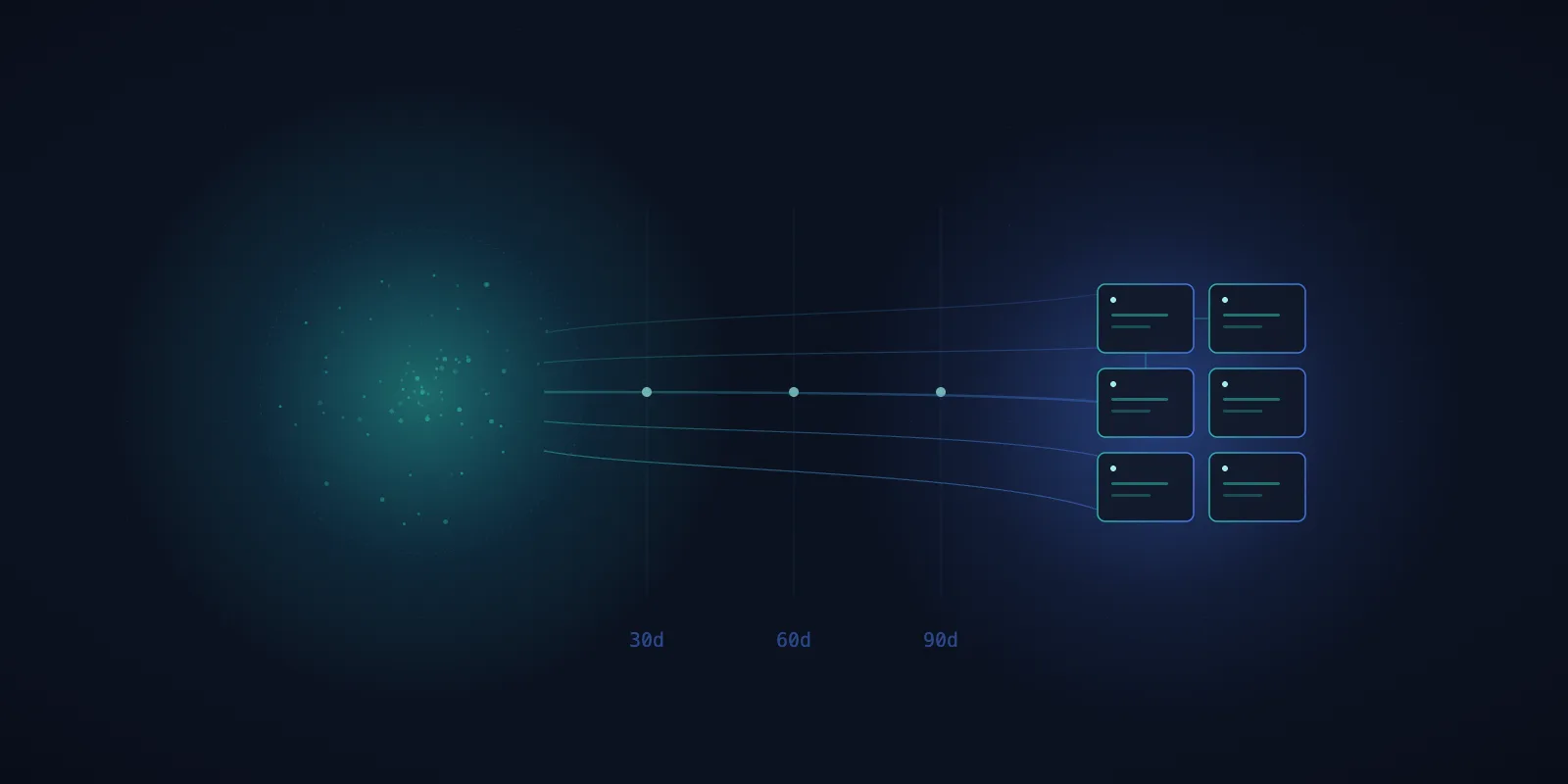
A leadership-development company in German-speaking Europe is scoping a digital platform, and the original plan had the shape almost every plan has: build the business case, take the investment decision, then validate with customers. In a planning session this week the team inverted the middle of that sequence. Rough concept and a clickable prototype first, then validation with ten people, then the business case, then the decision. Nothing was added and nothing was cut. Only the order changed, and with it what each artifact is actually able to do.
The sequence everyone defaults to
Business case, decision, validation. It looks disciplined: you do the numbers before you spend, and you check with the market once the thing exists. It is also the order that produces the most confident-looking document at the moment you know the least. The team estimated that roughly 60 percent of the target group's needs are already understood from years of doing the work by hand. The remaining 40 percent is exactly the part that customer interviews would surface — which means it is also the part that decides whether the number in the business case is off by ten percent or by a factor.
What a business case can and cannot be
The cost side of this one is not the hard part. It is an hour estimate times a rate, plus external items — hosting, licences, legal, data protection. Those are knowable now. The revenue side is a pricing assumption multiplied by an assumed number of active users, and that product is the entire break-even. Both factors sit inside the 40 percent nobody has asked about yet.
So the artifact is not wrong, it is early. Written before validation, a business case is a priced assumption wearing the clothing of a calculation. Written after, the same spreadsheet with the same formulas prices findings instead. The formulas never change. What changes is whether anyone outside the room has touched the inputs.
Validation scheduled after the decision has exactly two possible outcomes: it confirms what was already funded, or it embarrasses someone. Neither one changes the plan.
Separate what is due anyway from what is being decided
The second move in the same session mattered as much and gets less attention. The cost picture was split into two levels. Level one is what has to happen regardless of whether the big platform is ever approved — in this case replacing a learning system that bills two separate accounts for two languages, exposes an API with three meaningful states, and has a support desk that no longer answers. That replacement is a five-figure cost with or without the platform decision.
Level two is everything variable: the platform itself, the AI module, the rest.
Keeping those in one number would have made a necessary migration a hostage of a large, uncertain decision. If the committee says no in December, level one still has to happen, and the team that has to do it should not spend three months waiting to find that out. Splitting the levels is not accounting hygiene. It is the difference between one decision and two.
The prototype is not a demo
The clickable prototype due at the end of October has a deliberately short requirement list: mobile layout, the company's own colours, all four modules visible with placeholder content, empty PDFs where documents will be. Explicitly not required: a working login.
That exclusion is the whole point. A prototype built to work invites the reaction "it works". A prototype built to be wrong in public invites people to say where it is wrong, which is the only output that moves the remaining 40 percent. Fifteen minutes of mockup already landed better with the principals than the written concept did — not because the mockup was better thought through, but because you can disagree with a picture.
What is still open
The honest part of this plan is the part most plans omit: the team wrote down its own confidence. Feasibility of the timeline, seven out of ten. Probability that the committee approves in December, around fifty percent. Both numbers were said out loud before anyone had to defend them, which is the only time such a number is worth anything.
The check worth running on your own roadmap: find the point where validation currently sits. If it sits after the funding decision, ask what result would still be allowed to change the plan. If the honest answer is none, then it is not validation — it is a review, and it should be scheduled and budgeted as one.
Hung Mai is a Germany-based freelance consultant for Digital Operations & Transformation, working remotely with international B2B clients.